
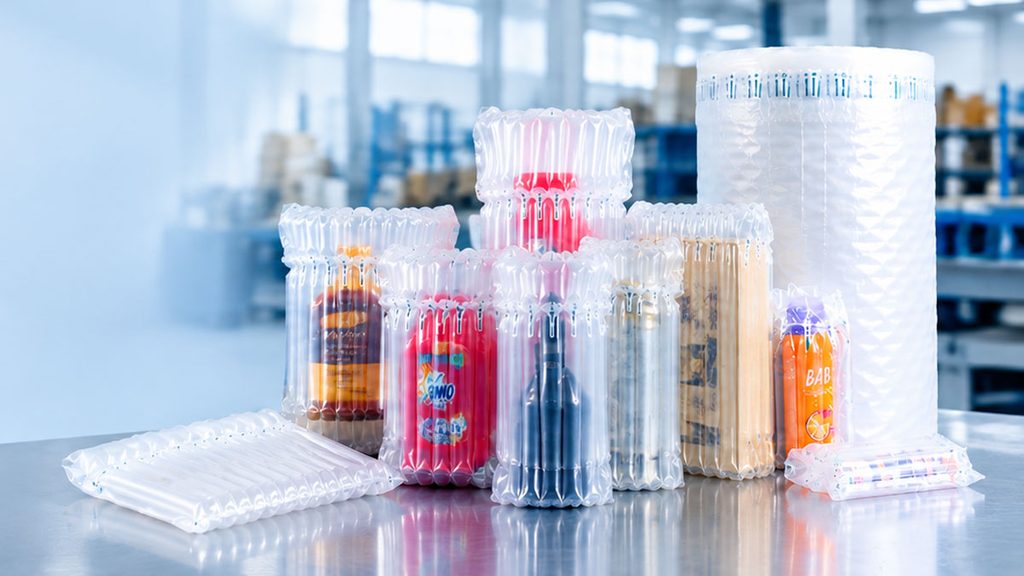
Air Column Bags for Glass Bottles: A Complete Shipping Guide
Glass bottles are widely used for wine, beverages, olive oil, essential oils, perfumes, and cosmetic products. However, their fragile structure makes them vulnerable to impact, vibration, and pressure during storage and transportation. For e-commerce sellers, distributors, and export businesses, choosing the right protective packaging for glass bottles is essential to reducing shipping damage and improving the customer experience.
Air column bags for glass bottles offer an inflatable cushioning solution designed to surround individual bottles and absorb some of the impact forces that occur during handling and transportation. They can be used as part of a protective packaging system for wine bottles, beverage containers, cosmetic bottles, and other fragile glass products.
In this guide, we explain how air column bottle packaging works, how to choose the right size, how it compares with bubble wrap, and what businesses should consider before ordering custom inflatable packaging.
What Are Air Column Bags for Glass Bottles?
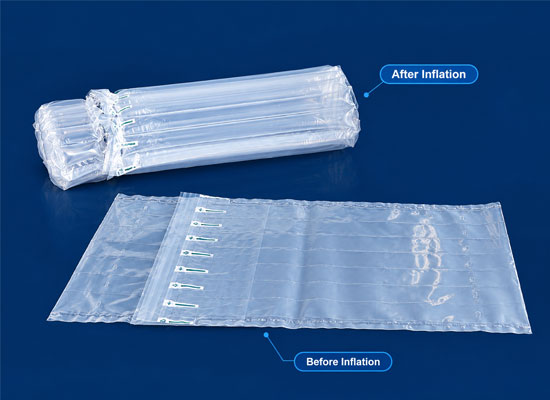
Air column bags are inflatable protective packaging products made from flexible plastic film. When inflated, multiple connected air chambers form a cushioning structure around the product.
An air column bag designed for a glass bottle typically follows the shape of the bottle, helping separate the glass surface from the outer shipping carton. The air chambers provide cushioning against certain impacts and help reduce unnecessary movement inside the package when the bag and carton are correctly sized.
Unlike loose-fill packing materials, bottle air column bags are designed to fit around a specific product shape. Depending on the design, they may protect the bottle body, shoulders, neck, and base.
Common applications include:
- Wine and champagne bottle shipping
- Olive oil and vinegar glass bottles
- Beverage and juice containers
- Perfume and fragrance bottles
- Essential oil and cosmetic glass containers
- Other fragile cylindrical products
For businesses shipping multiple bottle sizes, custom air column bags can be developed to match different product dimensions and packaging requirements.
How Do Air Column Bags Protect Glass Bottles During Shipping?
Glass can crack when exposed to concentrated impact forces or when bottles collide with one another. Effective shipping packaging should therefore do more than simply fill empty space.
1. Cushioning Against Impact
Inflated air chambers act as a cushioning layer between the glass bottle and its surroundings. When an impact occurs, the chambers can deform and help absorb some of the force before it reaches the bottle.
The actual level of protection depends on the bag design, film properties, inflation condition, bottle weight, and shipping environment.
2. Reducing Bottle Movement
A properly sized inflatable bottle bag helps hold the bottle in position inside the shipping carton. Reducing excessive movement can lower the chance of bottles hitting the carton walls or colliding with other products.
The outer carton must also be appropriately sized, with sufficient protection around the packaged bottle.
3. Separating Individual Bottles
When several glass bottles are shipped together, direct contact between bottles can create a risk of chips, scratches, or breakage.
Individual air column packaging can provide a cushioning barrier around each bottle. For multi-bottle shipments, carton dividers or other suitable separation systems may still be necessary.
4. Supporting Efficient Packing Operations
Air column bags are typically supplied in a deflated form and inflated when needed. This can reduce the storage space required for protective packaging compared with some preformed cushioning products.
For businesses handling different bottle sizes, a suitable range of inflatable packaging formats may also simplify packing operations.
Important: Air column bags can help reduce shipping damage, but they cannot guarantee that a glass bottle will never break. Heavy bottles, sharp bottle features, poor carton design, incorrect inflation, and severe impacts can all affect performance.
How to Choose the Right Air Column Bags for Glass Bottles
Choosing the right inflatable packaging requires more than measuring the bottle’s height. Buyers should consider the product’s dimensions, weight, shape, and distribution conditions.
1. Measure the Bottle Dimensions
Measure the bottle’s total height, maximum body diameter, shoulder shape, neck diameter, and base dimensions where relevant.
For tapered or unusually shaped bottles, provide a product drawing or photographs from multiple angles. This helps packaging suppliers assess the required bag shape more accurately.
2. Consider Bottle Weight and Fragility
A lightweight cosmetic bottle and a heavy wine bottle may require different packaging specifications.
When selecting inflatable bottle packaging, consider:
- Empty bottle weight and filled product weight
- Glass thickness and fragile areas
- Bottle neck and shoulder geometry
- Whether the bottle contains liquid
- The expected handling and transportation conditions
Heavier products may require a more robust packaging structure and additional protection inside the carton.
3. Check Film and Air Chamber Specifications
The film structure, thickness, chamber dimensions, and sealing quality influence packaging performance.
Rather than selecting a bag based only on film thickness, buyers should assess the complete packaging design and request samples for evaluation.
4. Match the Bag to the Shipping Carton
Even a well-designed air column bag may perform poorly if the outer carton is too large, too weak, or unable to prevent excessive movement.
The complete packaging system should account for bottle clearance, cushioning space, carton strength, stacking conditions, and the expected shipping route.
5. Request Samples Before Bulk Ordering
For new packaging projects, test samples with the actual bottle and intended carton before placing a large order.
This is particularly important for export shipments, high-value products, and glass bottles containing liquids.
Air Column Bags vs. Bubble Wrap for Glass Bottles
Both inflatable air column bags and bubble wrap can be used to cushion fragile products. The better choice depends on the bottle design, packing volume, labor requirements, and protection targets.
| Comparison | Air Column Bags | Bubble Wrap |
|---|---|---|
| Packaging format | Inflatable structure designed around a product | Flexible cushioning material wrapped around a product |
| Before use | Usually stored deflated | Usually stored as a roll or sheet |
| Bottle fit | Bottle-specific designs may provide a consistent fit | Fit depends on wrapping method and number of layers |
| Packing workflow | Can simplify repetitive packing when sizes are standardized | Requires wrapping and securing each bottle |
| Multiple bottle sizes | Different bag sizes or custom designs may be needed | One roll can accommodate many shapes |
| Protection performance | Depends on design, inflation, and carton configuration | Depends on material, thickness, wrapping, and carton configuration |
| Best selection method | Test the complete packaging system | Test the complete packaging system |
Neither material is automatically superior for every shipment. Businesses should compare total packaging cost, packing time, damage rates, storage needs, and product presentation.
For certain high-risk shipments, combining air column bags with carton dividers, protective sleeves, or other cushioning materials may be appropriate.
How to Pack Glass Bottles with Air Column Bags
A consistent packing procedure helps businesses evaluate and maintain packaging performance.
Step 1: Inspect the Bottle
Check the bottle for cracks, chips, sharp edges, and irregular shapes. Make sure the bottle is clean and dry before packing.
Step 2: Select the Correct Air Column Bag
Choose a bag that matches the bottle’s dimensions and weight. Avoid using a bag that is excessively loose or too tight around the product.
Step 3: Inflate According to the Product Instructions
Use the compatible inflation method and follow the packaging supplier’s instructions. Check that the air chambers are inflated appropriately and that the seals remain intact.
Avoid assuming that maximum inflation always provides the best cushioning.
Step 4: Insert the Bottle Carefully
Place the bottle into the protective bag without forcing it through a narrow opening or allowing sharp edges to damage the film.
Check that the bottle is adequately supported, including its body and other vulnerable areas.
Step 5: Place the Packaged Bottle in the Outer Carton
Use a suitable shipping carton and additional cushioning or dividers where necessary. Prevent excessive movement while avoiding unnecessary pressure on the bottle.
For bottles containing liquids, consider secondary containment measures appropriate to the product and applicable shipping requirements.
Step 6: Test the Complete Packaging System
Evaluate representative packed samples under relevant handling, vibration, compression, and drop conditions. Use a suitable test procedure for the shipping channel and destination requirements.
Record the results and adjust the bag size, carton, dividers, or cushioning as needed before scaling up production or ordering.
Which Industries Use Air Column Bags for Glass Bottles?
Wine and Beverage Packaging
Wine, champagne, juice, and specialty beverage bottles often require cushioning against impact during distribution. Bottle-shaped inflatable packaging can help separate and protect individual bottles inside a shipping carton.
Olive Oil and Food Products
Glass bottles containing olive oil, vinegar, sauces, and other food products require both physical protection and appropriate liquid containment.
Inflatable cushioning can help protect the glass, but it should not be treated as a substitute for leak prevention or food-related packaging requirements.
Perfume and Cosmetic Packaging
Perfume bottles and premium cosmetic containers may have distinctive shapes, decorative caps, and fragile glass surfaces. Custom-sized air column bags can help accommodate these product features.
Essential Oils and Small Glass Containers
Small glass bottles may be shipped individually or in grouped cartons. The correct solution depends on the bottle dimensions, product value, shipping method, and number of units per package.
What Should You Consider When Ordering Custom Air Column Bags?
For B2B buyers, the most suitable packaging solution should match the actual product and packing process rather than rely on a generic bag size.
Before requesting a quotation, prepare the following information:
- Bottle dimensions: Height, body diameter, neck size, and base shape
- Product weight: Empty bottle weight and filled weight
- Bottle type: Wine, beverage, olive oil, perfume, essential oil, or another glass product
- Packaging quantity: Expected order volume and packing frequency
- Shipping method: Parcel delivery, courier, air freight, sea freight, or distribution through a fulfillment center
- Outer carton: Carton dimensions, structure, and number of bottles per carton
- Customization requirements: Bag dimensions, chamber layout, material specifications, and branding needs
- Testing requirements: Drop testing, compression testing, or other relevant validation
A packaging supplier can use these details to help assess the appropriate product design and recommend sample testing before bulk purchasing.
At Green GaoShu, we focus on protective packaging solutions for business customers. We can discuss product dimensions, packaging applications, and customization requirements to help identify a suitable air column packaging option. Final specifications should be confirmed through product evaluation and testing.
Frequently Asked Questions About Air Column Bags for Glass Bottles
Are air column bags good for shipping glass bottles?
Air column bags can provide cushioning around glass bottles and help reduce movement and impact exposure during shipping. Their effectiveness depends on the product design, bottle weight, inflation condition, outer carton, and transportation environment. Testing is recommended before regular use.
Can air column bags prevent glass bottles from breaking?
No packaging material can guarantee zero breakage under all shipping conditions. Properly selected air column bags can help reduce damage risk, but the bottle, carton, internal separation, and handling conditions must be considered together.
Are air column bags better than bubble wrap for wine bottles?
It depends on the bottle shape, packing volume, labor costs, storage requirements, and protection targets. Air column bags may provide a more standardized fit for bottle-specific packaging, while bubble wrap offers flexibility for different product shapes. Testing both options can help determine the best solution.
Can I order custom size air column bags for glass bottles?
Custom dimensions and structures may be available depending on the packaging design and supplier capabilities. Provide the bottle dimensions, weight, photographs, and intended carton configuration when requesting a quotation.
Are air column bags suitable for shipping multiple glass bottles in one carton?
They can be used for individual bottle cushioning within a multi-bottle carton. Appropriate dividers, carton strength, and clearance between packaged bottles should also be considered to reduce the risk of bottle-to-bottle contact.
Do air column bags need to be inflated before use?
Yes. Inflatable bottle packaging must be inflated according to its design and supplier instructions before the bottle is packed. The required inflation equipment and procedure depend on the product format.
Can air column bags be used for bottles containing liquids?
Yes, they can provide cushioning for glass containers holding liquids. However, they do not replace leakproof closures, secondary containment where needed, or applicable requirements for shipping liquids.
How can I choose an air column bag supplier for glass bottle packaging?
Compare product customization capabilities, material specifications, sample availability, quality control procedures, communication, and experience with similar bottle applications. Request samples and test the complete packaging system before confirming a large order.
Conclusion: Find the Right Protective Packaging for Glass Bottles
Air column bags for glass bottles can be a practical option for businesses that need cushioning, a product-specific fit, and an efficient packing workflow. However, reliable protection comes from selecting the right bag and combining it with a suitable outer carton, internal separation, and appropriate testing.
Whether you ship wine bottles, olive oil containers, perfume bottles, or other fragile glass products, start with the actual product dimensions and shipping conditions before selecting a packaging solution.
Looking for custom air column bags for glass bottles?
Contact Green GaoShu to discuss your bottle dimensions, order quantity, packaging requirements, and potential customization options. We can help you explore suitable protective packaging solutions for your business.